FLUID
Fluid carries us through the work by orchestrating time, space and pressure so that emotion can build, land and carry us into what comes next.
Without Fluid, things can still happen and mean something, but they struggle to make us feel.
The Fluid has intangible aspect. It is an element of flow that transcends, mixes and spatialises the piece.
Of all five faces, Fluid is perhaps the closest to experience itself. Spice can give us something to notice. Bedrock can give us a world to inhabit. Web can give us something to understand. Death can make the experience feel existentially unavoidable. Fluid is what carries all of this through time. It is the current in which the rest of the story is experienced.
This is why reducing Fluid to pacing would be a mistake. Pacing is part of it. Editing is part of it. Rhythm is part of it. Pressure, spatial orientation, buildup, release, silence, cuts, ellipses and movement are all part of it. But none of them alone is Fluid.
Fluid is the organization of movement through experience.
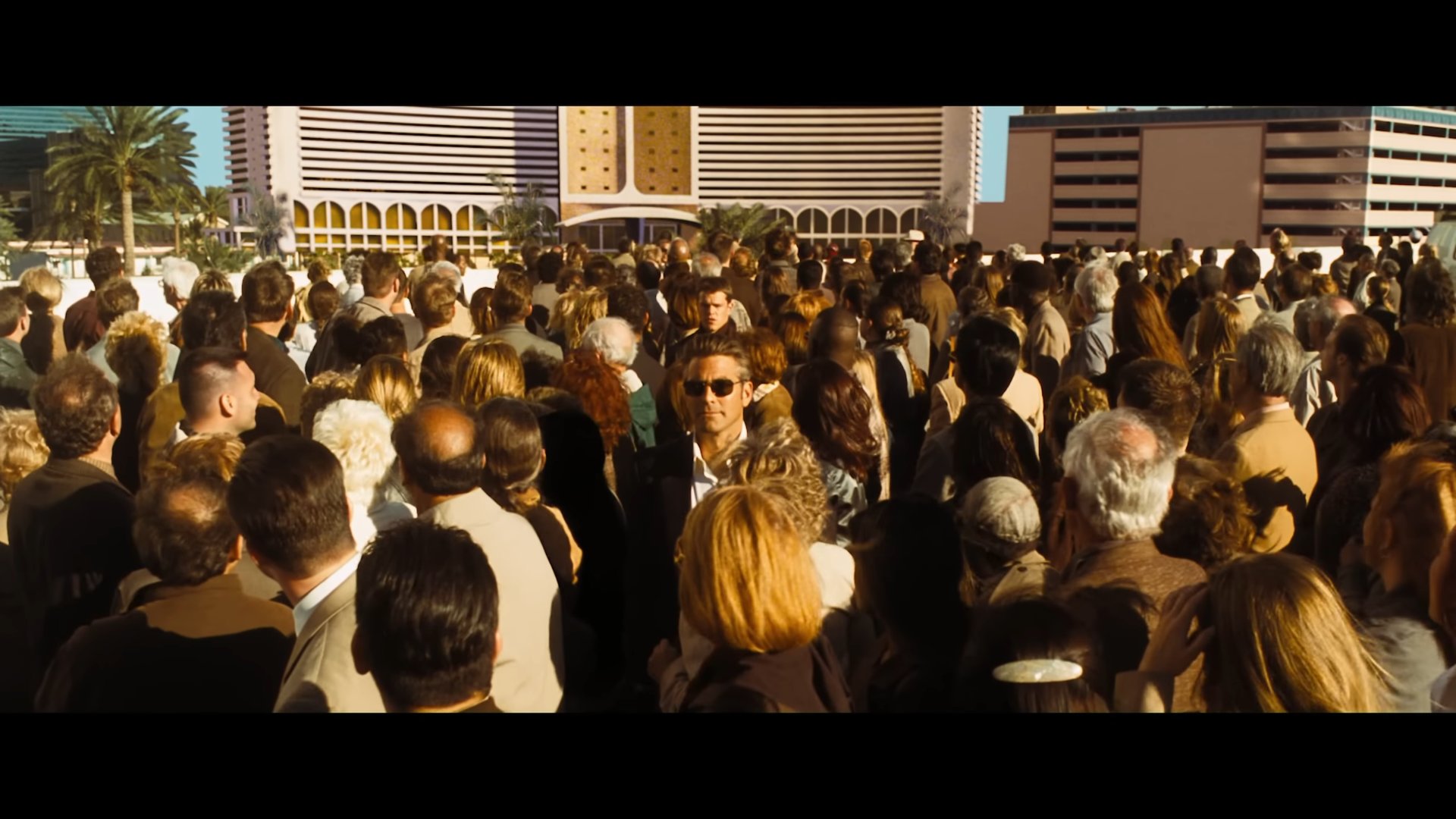
Fluid: Ocean’s Eleven
Ocean’s Eleven moves like an excellent piece of jazz.
Its dialogue, editing, music, entrances, exits, reveals, plans and character handoffs keep passing momentum from one moment to the next. The rhythm rises, relaxes, redirects and rises again. Information is continually being withheld, delivered or reframed at the right moment. The film feels choreographed rather than merely assembled.
What matters is not that it is always fast. It is that it is always carrying us.
A useful contrast is Uncut Gems, which demonstrates the same face through almost the opposite emotional texture. Where Ocean’s Eleven carries through smoothness, confidence and rhythm, Uncut Gems carries through anxiety. It rarely lets us breathe. The moment one pressure appears to resolve, another catches us and pushes us forward.
Both show the same underlying property: Fluid can make disengagement feel difficult because the present moment is constantly leaning into the next.
Change is the natural language of story
Change is the natural language of story.
Stories move through states. Something is one way, then another. A relation changes. A character learns something. A threat appears. A room becomes dangerous. An answer creates another question. A conversation turns. A body crosses a space. A silence lasts long enough to alter the meaning of what came before it.
For that reason, Fluid is by essence non-linear.
By non-linear, I do not simply mean that a story can jump around in chronology. I mean that fluidity contains twists and turns, rises and falls, acceleration and slowdown, buildup and release, changes of direction and changes of intensity. A perfectly straight line moving at one speed may still be movement, but it has very little fluidity.
Any state should be understood as a transient state inside a larger cycle. It may last for a second or for half a movie. It may remain almost perfectly stable for a long time. But insofar as it participates in Fluid, it exists relative to what came before it and what may come after it.
A useful way to think about this is:
If a value is not turning, it should be building toward a turn.
A turn does not have to mean a physical reversal. It is a change in the interpretative value or direction of the flow.
Imagine a train moving forward. Nothing about its speed, direction or physical behavior changes. Then we learn that if the train reaches its destination, everyone onboard dies. The train has not turned. The scene has.
What changed is the meaning of the movement.
That distinction matters because a great deal of weak storytelling contains movement without turns. Things happen, then more things happen, then more things happen. The sequence progresses but does not transform. The famous shorthand of connecting beats through “but” and “therefore” rather than endlessly through “and then” is useful because it forces consequence and reinterpretation into the movement.
The froth. The wave. The storm.
Fluid operates at many scales at once.
The froth. The wave. The storm.
The froth is the local turbulence: a glance, a cut, a gesture, a change of sentence rhythm, a tiny pressure shift, a reaction landing half a second later than expected.
The wave is larger. A scene builds, turns and releases. A sequence gains direction. A conversation changes temperature. A chase accelerates, then opens into stillness, then finds another current.
The storm is the larger movement of the story: the accumulation of many waves into a directional force that can carry an entire film.
These are not rigid categories. They are simply a useful image for understanding that Fluid is nested. Small cycles live inside larger cycles. A scene can have its own rise and fall while simultaneously contributing to a much larger buildup. A quiet beat can interrupt one local current while strengthening the larger one.
This is why a story can feel extraordinarily Fluid even when individual moments are slow. The question is not whether every second is moving quickly. The question is whether the local movement belongs to a larger current.