Why a shadow can be pink
Cranberry glass, gold leaf and a porcelain plate in low sun: how a shadow fills with filtered light, why its edges run deeper in colour, where caustics come from, and why gold reflects in gold.
A shadow is usually described as an absence. For an opaque object that’s close enough. But glass doesn’t stop light. It lets it through, changes it, bends it, and sends it on, so the shadow of a glass object is not an empty place. It’s a second image of the object, made of whatever light survived the crossing.
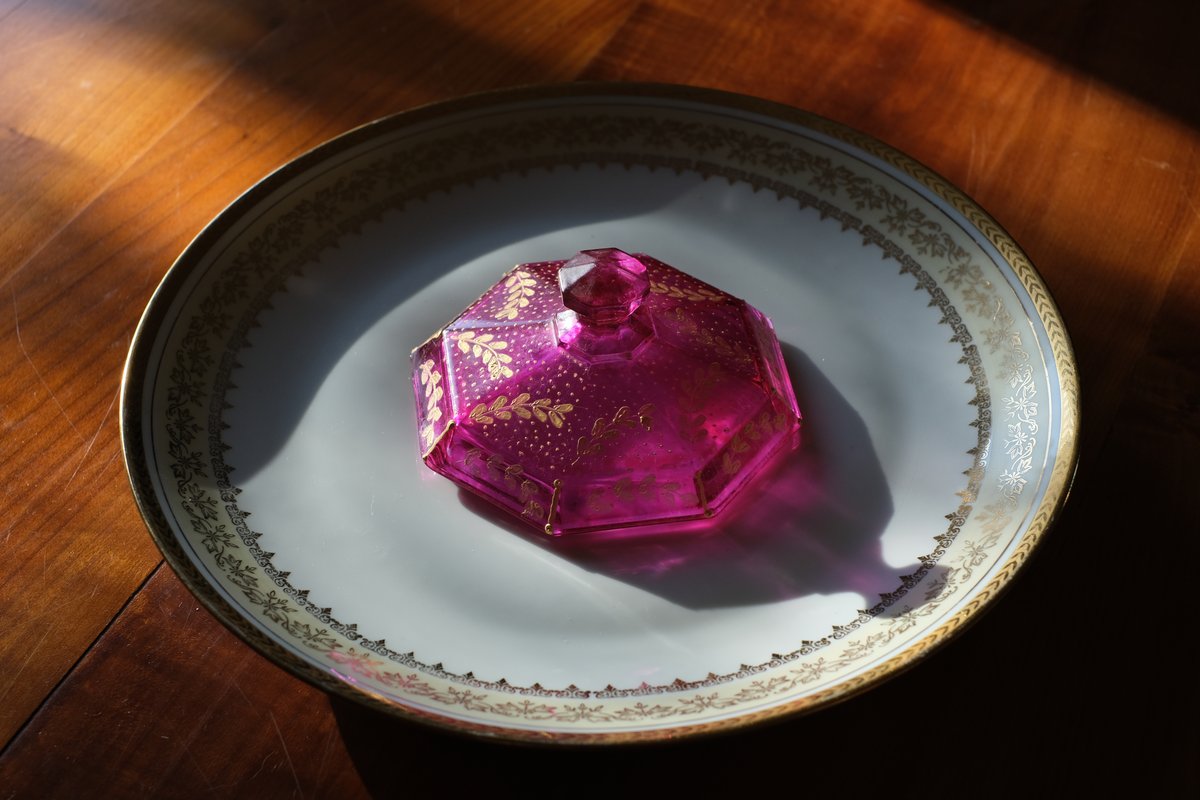
I set this lid and this plate in low sun and moved both, and the frame, until that second image was what the photograph was about. Nothing is cropped or edited. The colours are the ones the camera recorded on the day.
Filtering
Sunlight is a mixture of wavelengths that reads, together, as roughly white. Glass like this, a deep pink often called cranberry or ruby glass, absorbs a band in the middle of the spectrum, the greens, and lets the reds and blues through. Red plus blue minus green is magenta. That is the light that falls on the plate.
How much is absorbed depends on how far the light travels inside the glass. Each millimetre removes a fixed fraction, so intensity falls off exponentially with path length: the Beer–Lambert law. You can see it on the lid itself. Its flat panels, crossed at a short path, are a light, almost candied pink. Its edges and the faceted knob, where light runs through more glass or bounces around inside before leaving, are a much deeper, more saturated magenta. Colour, in glass, is a measure of distance travelled.
The same law draws the shadow. Where the sunlight has crossed one thin panel, the plate is lit a soft pink. Where it has crossed two walls, or a thick edge, the pink is darker and denser. The shadow is a map of thickness.
The plate as a screen
A white porcelain plate is close to an ideal screen. Its body scatters all wavelengths roughly equally, so it takes on the colour of whatever light arrives. Its glaze adds a thin glossy layer on top, which reflects a small part of the light directly, uncoloured, like the surface of the red enamel in another photograph. So in the pink area you get two things layered: the scattered magenta of the body, and, at grazing angles, a faint pale sheen from the glaze that softens it.
Outside the shadow, the plate receives full sunlight and is nearly white. The contrast between the two is what makes the pink legible at all.
Gathering: the caustics
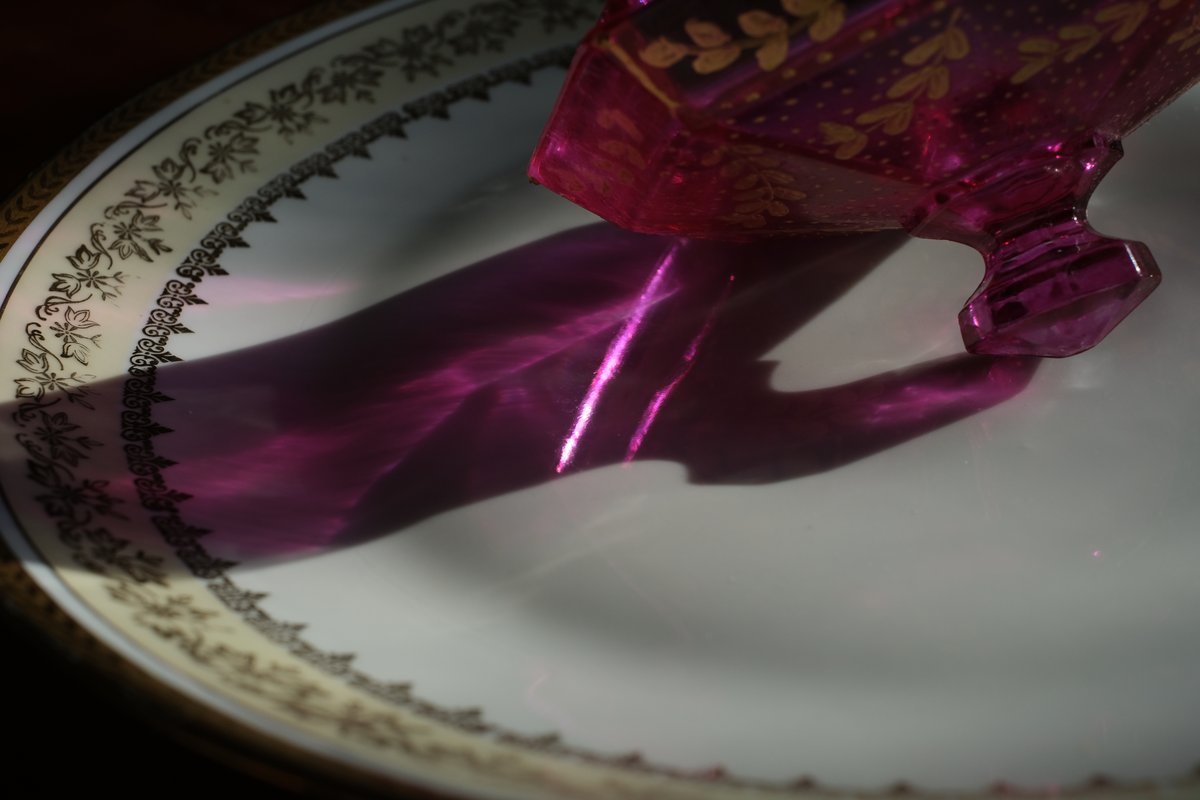
Closer in, the shadow is not uniform. Two bright lines run through it, brighter and paler than the magenta around them.
Glass bends light at every surface it crosses, by an amount set by its refractive index, around 1.5. A flat parallel panel shifts the light without concentrating it. But a curved surface or an angled facet acts as a small, imperfect lens: it takes light from a wider area and sends it into a narrower one. Where many refracted rays crowd together, they trace a bright curve on whatever surface catches them. That curve is a caustic, technically the envelope of a family of rays. It’s what draws the shifting net of light on the floor of a swimming pool, and the bright curve that appears in the bottom of a cup or a ring under a lamp.
These two lines come from the lid’s edges and facets, which deflect sunlight into thin sheets. Inside them the light has been concentrated enough to stand out clearly from the pink around it. Because the glass is still filtering it, a caustic in a pink shadow is itself pink, only brighter and less saturated, as if washed out by its own intensity.
Caustics are extremely sensitive to geometry. Rotate the lid by a few degrees, raise the sun by a few minutes, and the lines slide, merge, or vanish. That sensitivity is why this photograph needed so many small movements of the object before the lines sat where they do.
Gold reflects in gold
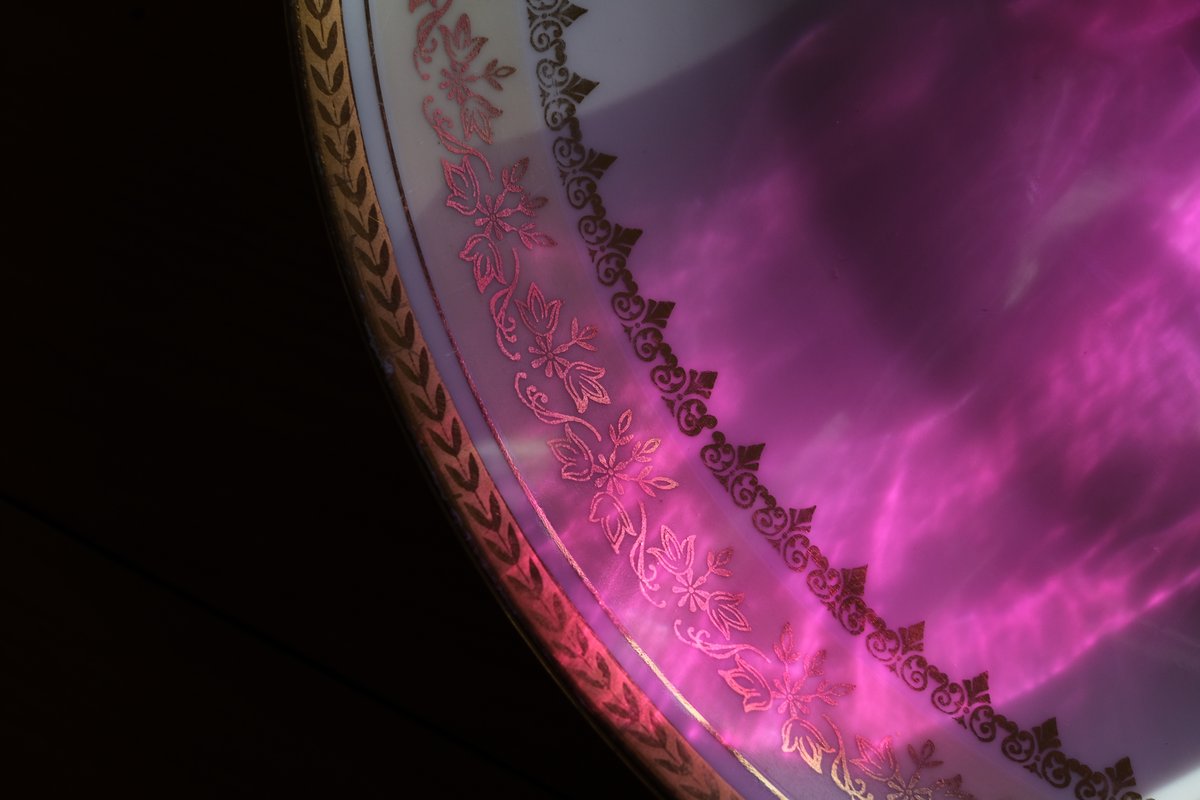
There’s a second kind of reflection in these frames, and it behaves differently. The leaves painted on the lid and the border of the plate are gold. Gold is a metal, and metals don’t reflect light in two layers like paint or glaze. Their colour is their reflection: they reflect strongly across the red and yellow and absorb more of the blue, so even the specular highlight on gold is golden. On the lid, the gilded leaves that face the sun flash a bright yellow-gold, while the ones that face away go a dark, warm brown. Both are the same gold, seen at angles that send more or less of the light toward the lens.
On the plate’s rim, the gold border sits inside the pink light. Gold reflecting magenta light becomes a rose gold, warm and pink at once. The rippling pattern across the rim comes from the slight irregularities in the glass: each small wave in the lid’s surface becomes a small wave of brightness on the plate.
The eye and the camera
Human vision adjusts for the overall colour of the light in a scene. A white sheet of paper looks white under warm lamplight and under blue daylight, though the light leaving it is very different. This is colour constancy. Cameras do something comparable through white balance, choosing a correction for the whole frame from an estimate of the light.
Both corrections work on the scene as a whole. A small, local patch of coloured light inside an otherwise white-lit scene isn’t neutralised by either. We see it, correctly, as coloured light falling on a white surface, and the camera records it as such. No grading was added afterwards. The magenta here is the magenta that was on the plate.
The same lid appears in Subjective Truth, where it isn’t there to explain anything.
Further looking: David Foster’s overview of colour constancy at the University of Manchester, for how we perceive surface colour under changing light.