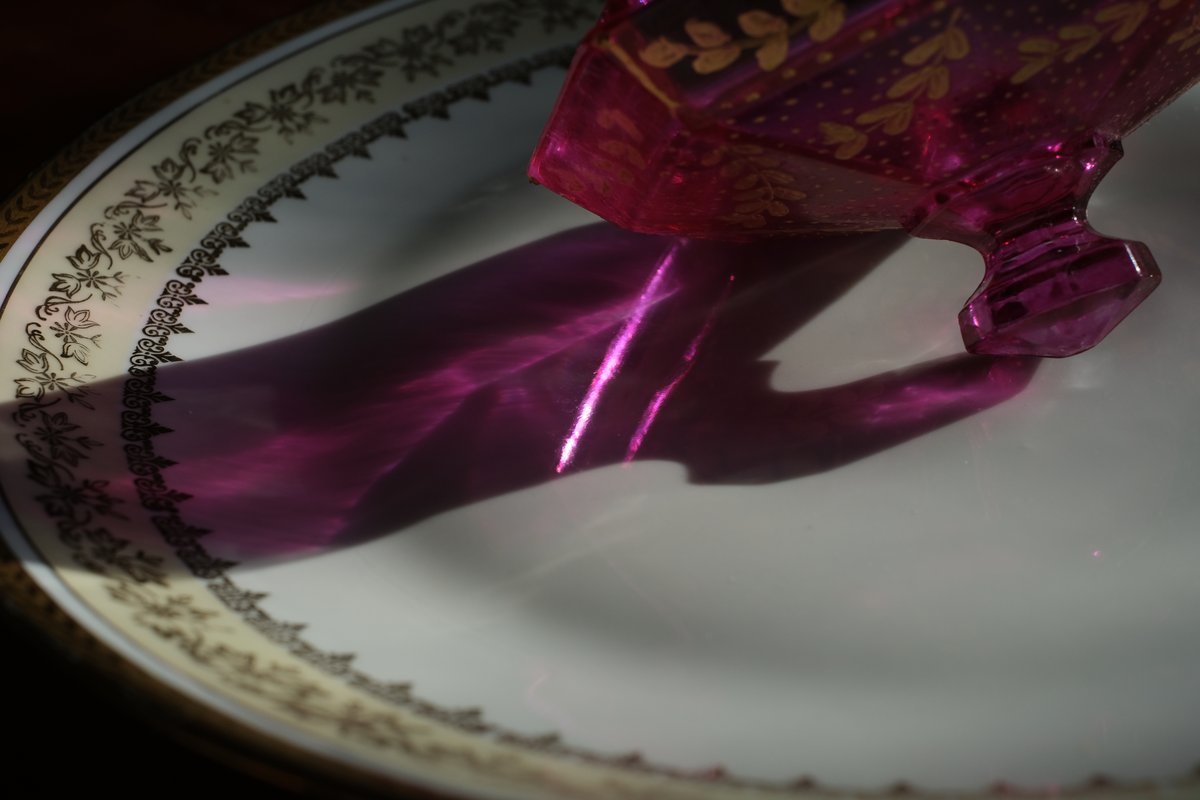
How light gives things their shape
Raking light on aggregate, light that travels inside a coconut, and the exact shape of a shine on red enamel: how direction, scattering and reflection decide what a surface becomes in a photograph.
Nothing in these photographs is accidental. Not the angle of the shadows, not the width of a highlight, not the grain of a surface where it turns from lit to unlit. I move, I move the object, I wait, and I press the shutter only when the textures, the light and the counter-light are what I want them to be. None of them has been cropped or edited afterwards. What follows is an attempt to say, as exactly as I can, what each of those decisions is made of.
There are three of them here. Where the light comes from. Whether it stops at the surface or goes inside. And what happens to the part that bounces straight back.
Light that skims
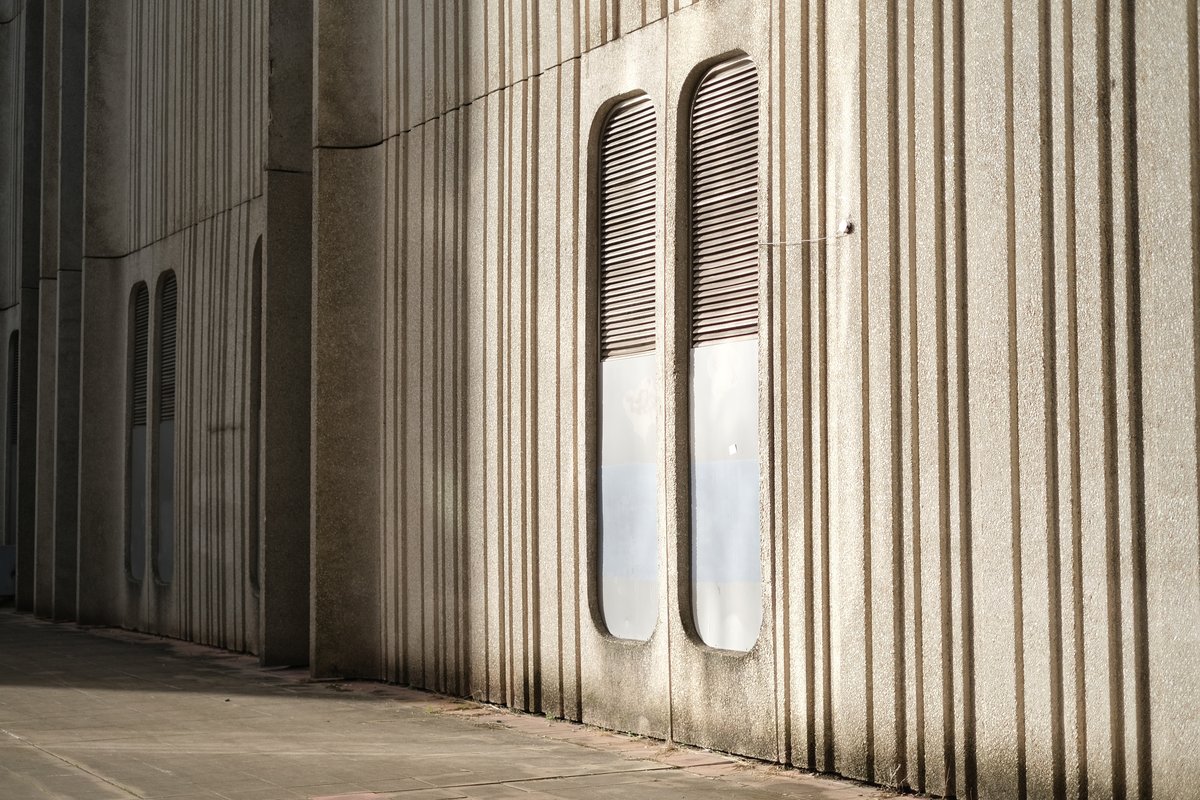
The wall is a ribbed render with an exposed aggregate: small stones sitting just proud of the cement. In flat light it would read as beige. Here the sun arrives low and from the side, almost along the plane of the wall, and the surface becomes a field of events.
Raking light works by geometry. A relief of height h, lit by a source at an elevation θ above the surface, throws a shadow of length h / tan θ. As θ approaches zero the shadow stretches without limit. A rib a couple of centimetres deep becomes a band of shadow many times wider than itself, and a grain of aggregate a millimetre high gets its own small shadow and its own small lit face. That is the texture you can see across the lit part of the wall: thousands of tiny terminators, each grain divided into a side that faces the sun and a side that doesn’t.
On the ribs, where the edge that casts each shadow is only centimetres from the wall, the shadows are almost razor-cut. (Why distance decides the sharpness of a shadow is the subject of another essay.) That crispness is part of what I wanted from this frame: the regularity of the ribs drawn by the light as if with a ruler, and the irregular grain of the aggregate scattered over it.
Then the wall turns. On the left, out of direct sun, the same ribs are lit only by the sky and by light bounced off the pavement. That light comes from a whole hemisphere at once, so it reaches into each groove almost as well as it lights each rib, and the relief collapses into faint changes of tone. Same surface, same minute, two completely different materials. The frame holds both, so the eye can go back and forth across the turn.
Light that goes inside
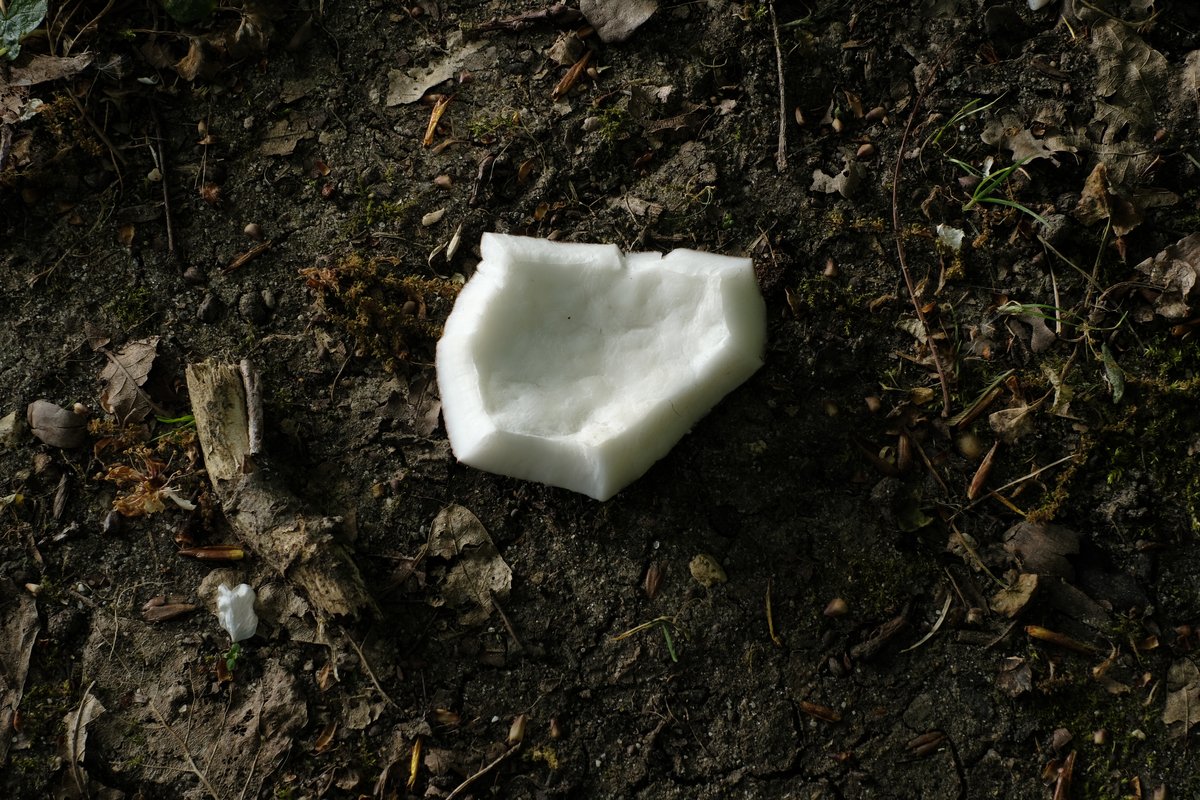
Coconut flesh is not a surface in the way concrete is. It’s a dense, wet, fibrous solid, and a good part of the light that reaches it doesn’t bounce off the outside at all. It enters, scatters among the fibres and the water and the fat, and comes back out somewhere else, a little way from where it went in. This is subsurface scattering, the same thing that makes skin, wax, marble and milk look soft and alive rather than chalky.
You can see it in three places. The broken edges glow slightly, because light can leak out through the thin walls. The transition between the lit side of each facet and the shaded side is gentler than the geometry alone would give, because light travelling inside the flesh carries brightness past the edge. And the cut faces have a waxy depth, a faint translucency at the rim where the white meets the thin brown skin.
The light here is wide and soft: no hard shadow anywhere around the piece, the forest floor lit evenly. That was the condition for this photograph. Under direct sun, the flesh would have clipped to flat white and the scattering, which lives in very small differences of brightness, would have disappeared. In open shade, the whole piece sits within a narrow band of near-whites, and every shift inside that band is information: the cooler grey of the hollow, which faces the open sky; the warmer white of the walls; the brightest lines along the breaks. Against the dark, wet earth, which reflects almost nothing, those few tones are enough to build the entire volume.
The shape of a shine
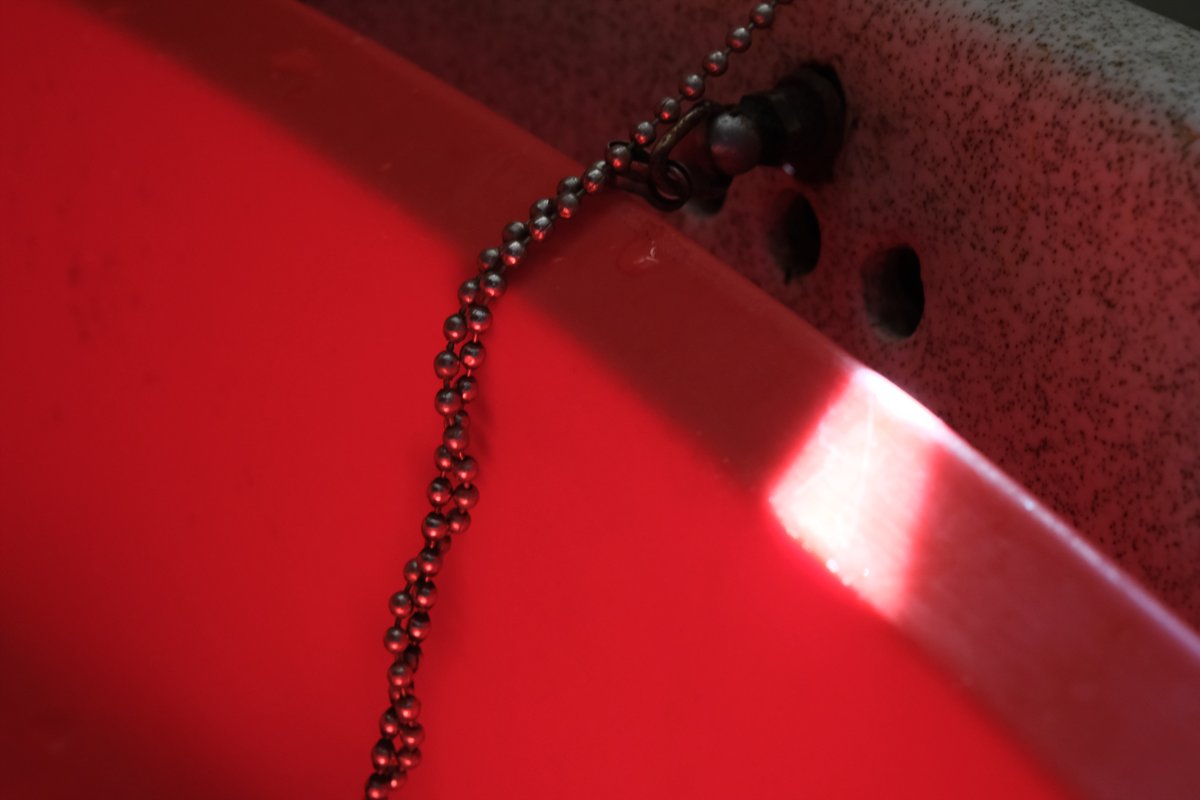
Glossy paint reflects light in two layers. Below the surface, the pigment absorbs most of the spectrum and scatters back the red: that’s the colour of the basin. On the surface, the smooth top layer of the enamel reflects a small fraction of light directly, like a weak mirror, before it ever reaches the pigment. That surface reflection doesn’t take on the colour of the paint. It stays the colour of the light.
How much is reflected at the surface depends on the angle. The Fresnel equations describe it: for a material like glass or glossy paint, only about four percent of light is reflected straight back at normal incidence, but the proportion climbs steeply as the angle becomes grazing, towards total reflection at the very edge. So the same red rim can be deep red where you look into it and nearly white where it curves away from you towards the light.
Where the strip of sun lands on the rim, the specular reflection overwhelms the red and the paint turns a pinkish white. The shine is not a blob. It has a shape, and the shape is a portrait of two things at once: the source, and the surface. The source is a narrow band of sunlight with fairly sharp sides, so the highlight has sharp sides. The surface is a curved rim, so the highlight stretches along the curve and fades across it. And the enamel is not perfectly smooth. Its microscopic roughness, the tilt of millions of tiny facets, spreads the reflection into a soft sheen rather than a hard mirror image. Across the patch you can find the history of the object: a fine scratch running through it, a few bright beads of water or dust along its lower edge, each one catching the light at its own angle.
Further along, the rim’s crest picks up a thin, continuous white line. That’s the same mechanism at a different scale: the narrow curved top of the rim reflects a bright part of its surroundings, and only the thin line of surface tilted exactly right sends it to the lens.
And the red doesn’t stay inside the basin. Light leaving the red surface lands on the speckled enamel wall above it and tints it a faint rose. In rendering, this is called colour bleeding; it is simply light bouncing twice. The cool grey of that wall in the shadowed corner, and its warm pink where it faces the red, are the same paint lit by different neighbours.
The ball chain sits across all of this as a counterpoint: dozens of small metal spheres, each holding its own tiny reflection of the light. A sphere reflects the whole world in a single point, so each bead carries a bright pinpoint and a dark rim. Dozens of highlights in a line, each placed exactly by the position of the light and the lens.
What decides
Direction, depth and surface: three questions, asked of every frame. Where should the light be, relative to this surface, so that its relief becomes what I want? Should it stop at the skin or travel inside? What shape will the shine take, how wide, how sharp, how coloured? In video it’s the same, frame after frame. When the answers aren’t right, the picture isn’t taken.
The four photographs in The Study of Light are those answers.
Further looking: Cambridge in Colour’s guide to portrait lighting shows direction and softness under controlled light. For the physics of reflection at a surface, any introduction to the Fresnel equations and microfacet models of rough surfaces goes further than this essay can.