What makes a shadow soft
Umbra, penumbra and the half-degree width of the sun: why the edge of a shadow is a measure of distance, and what a barrel under a tree shows about leaves, oak and steel.
The edge of a shadow is the most precise thing in a photograph. It tells you how big the light was, how far the object is from the surface it falls on, and what that surface is made of. Hard or soft, a shadow edge is never a matter of style. It’s geometry, and I place it like anything else in the frame.
Umbra and penumbra
Imagine standing on the surface where a shadow falls and looking back toward the light. Where the object hides the whole light source, you’re in the umbra: full shadow. Where it hides none of it, you’re in full light. In between, where the object covers only part of the source, you’re in the penumbra, and the brightness there depends on how much of the source you can still see.
So the width of a shadow’s soft edge depends on two things only: the angular size of the light as seen from the surface, and the distance between the edge that casts the shadow and the surface that receives it. A larger source, or a greater distance, widens the penumbra. A smaller source, or a shorter distance, sharpens it.
The sun is a large object very far away. From the earth it covers an angle of about half a degree. That’s small enough to give hard shadows, but not infinitely hard: every metre between the casting edge and the surface adds about nine millimetres of penumbra. A shadow cast by something touching the surface is razor-sharp. The same object a few metres away throws a shadow whose edge has dissolved into a gradient several centimetres wide.
An overcast sky is the opposite case: a source spanning most of a hemisphere. Its penumbra is so wide that there’s barely any umbra left at all, only a gentle darkening beneath things. That’s why shadows on a grey day seem to have no edges.
Reading the barrel
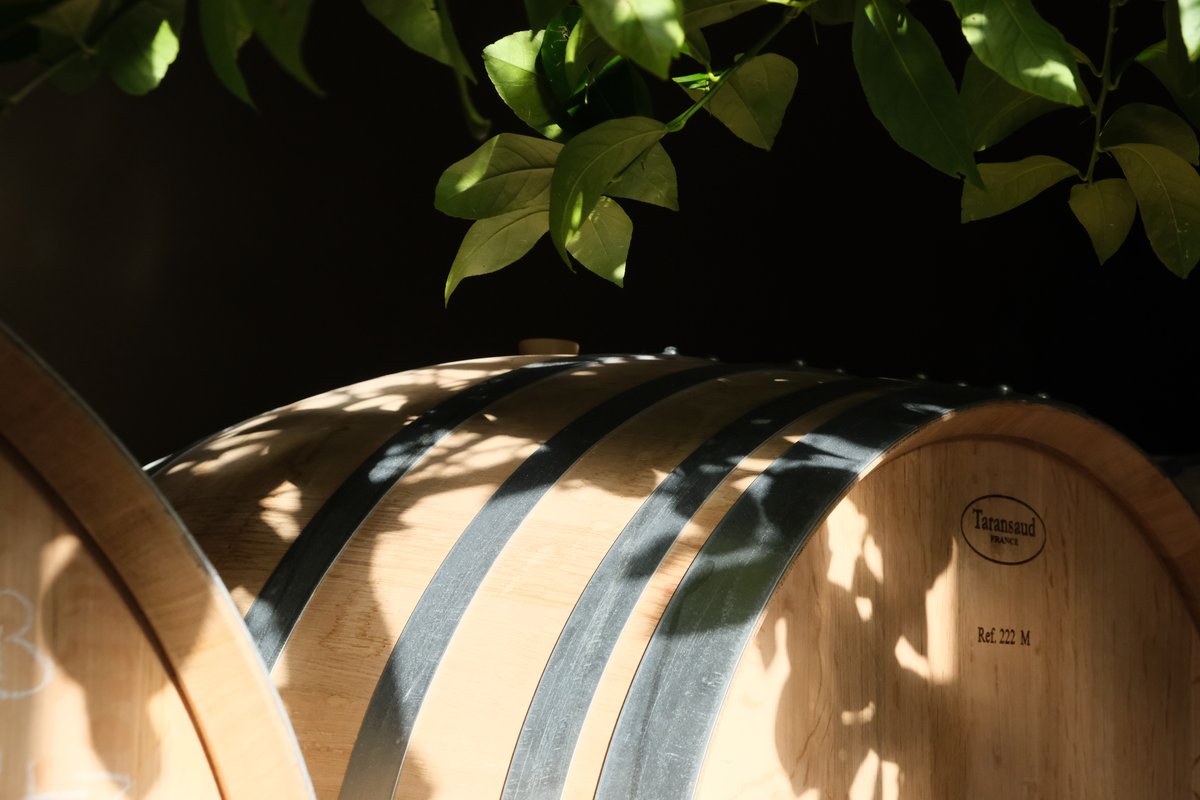
The shadows on this barrel come from the leaves of a tree some way above it, and every leaf is at a different distance from the wood. So the shadows are not one softness but many. Leaves near the barrel draw shapes you can still recognise, with almost crisp outlines. Leaves farther up dissolve into broad, cloudy patches whose edges have widened by centimetres. The softness of each patch is a measurement of how far its leaf is from the wood.
Where light passes through a small gap between leaves, something else happens. A small opening far from a surface behaves like a pinhole: it projects an image of the light source itself. Through a gap in a canopy, that image is a little picture of the sun, which is why sunlight under trees so often lands in small, rounded spots, whatever the shape of the gap. Some of the brightest flecks on the barrel have that rounded, slightly blurred look.
Two materials in the same shadow
The same shadow falls across oak and steel, and they answer it differently.
The oak is a diffuse, porous surface. Light entering it scatters among the fibres and comes back out in all directions, coloured by the wood. In full sun the staves are a warm pale gold, with the grain showing as fine variations in tone. In shadow they stay warm, only darker, because the light that still reaches them, scattered from the surroundings, is coloured by the same wood and the same leaves.
The hoops are steel, and steel reflects much more than it scatters. Where the sun reaches them, they carry a broad, streaky sheen. The streaks run along the hoop because the metal is covered in fine scratches running the same way. A surface scratched in one direction spreads its reflections perpendicular to the scratches, so the highlight stretches across the band. Where the hoops fall into shadow, they don’t simply go dark. They turn a cool blue-grey. A shadowed metal surface is still reflecting whatever is in front of it, and part of what’s in front of these hoops is open sky.
So inside the same leaf shadow, the wood goes warm and dark, and the steel goes cool. Same shadow, two temperatures.
The heads of the rivets along the top of the barrel carry one more kind of light: each small dome reflects the sun as a single pinpoint, the way a polished sphere gathers the whole scene into one spot.
Choosing the edge
Every shadow in a frame is a choice of distance and source. Move the object toward the surface and its shadow sharpens. Wait for a cloud and every edge in the scene softens at once. Step back so that more leaves stand between the sun and the wood, and the pattern on the barrel gets denser and softer. This photograph holds a particular mixture: sharp enough near the hoops to follow the leaves, soft enough across the barrel head that the shapes become weather rather than outlines.
The barrel is one of the photographs in Ambient Colors.
Further looking: Cambridge in Colour’s guide to portrait lighting shows the same principle under studio light: move a softbox closer, and the shadows on a face soften.